The collision map
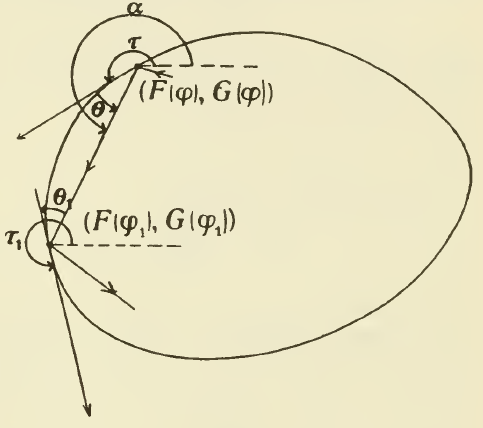
Let \(\Omega\subset\mathbb R^2\) be a bounded strictly convex table whose boundary \(C=\partial\Omega\) is a regular analytic simple closed curve with strictly positive curvature. Write its length as \(L\), and choose a counterclockwise arclength parametrization \(\gamma:\mathbb R/L\mathbb Z\to C\). At \(\gamma(s)\), let \(\tau(s)=\gamma'(s)\) be the unit tangent and \(n(s)\) the inward unit normal.
A collision state consists of a boundary position and an outgoing unit vector pointing strictly into the table. Write that vector as
$$u=\cos\theta\,\tau(s)+\sin\theta\,n(s),\qquad 0<\theta<\pi.$$Thus \(\theta\) is measured from the positive tangent toward the interior. Tangent directions, also called grazing states, are excluded. The state space in these coordinates is the open cylinder \(A_\theta=(\mathbb R/L\mathbb Z)\times(0,\pi)\).
Follow the ray \(\gamma(s)+tu\), \(t>0\), to its unique next boundary point \(\gamma(s_1)\). If \(N_1=-n(s_1)\) is the outward unit normal there, the reflection law gives the new outgoing vector
$$u_1=u-2(u\cdot N_1)N_1.$$It reverses the normal component and preserves the tangential component. Let \(\theta_1\in(0,\pi)\) describe \(u_1\) at \(s_1\) by the same convention. The billiard map sends \((s,\theta)\) to \((s_1,\theta_1)\) in \(A_\theta\). Non-tangent intersection and smooth reflection make the map smooth; tracing a reflected trajectory backward gives its smooth inverse.
Momentum coordinates
Set \(p=u\cdot\tau(s)=\cos\theta\), the tangential velocity (or momentum for unit mass). Since \(0<\theta<\pi\), this is a coordinate change to \(A=(\mathbb R/L\mathbb Z)\times(-1,1)\). In these coordinates write the same map as
$$T:A\longrightarrow A,\qquad T(s,p)=(s_1,p_1),\qquad p_1=u_1\cdot\tau(s_1).$$1. Differentiate the chord length
For distinct boundary positions \(s,r\in\mathbb R/L\mathbb Z\), define the smooth function \(H(s,r)=|\gamma(r)-\gamma(s)|\) and the unit chord vector \(w=(\gamma(r)-\gamma(s))/H(s,r)\). The variables \(s,r\) are independent; each partial derivative holds the other fixed. Differentiation gives
$$H_s=-w\cdot\tau(s),\qquad H_r=w\cdot\tau(r).$$On a flight, \(r=s_1(s,p)\) and \(w=u\). Reflection preserves tangential velocity at the second endpoint. Thus
$$p=-H_s(s,s_1),\qquad p_1=H_r(s,s_1).$$Write \(\ell:A\to(0,\infty)\), \(\ell(s,p)=H(s,s_1(s,p))\), for the flight length. These identities express the collision map in terms of one scalar function.
2. The canonical form and exact symplecticity
On the collision cylinder \(A\), define the one-form \(\lambda=p\,ds\): on a tangent vector \((\delta s,\delta p)\), it has value \(p\,\delta s\). Its negative exterior derivative is the two-form
$$\omega=-d\lambda=ds\wedge dp.$$The form \(ds\) is global on the circle although a real-valued coordinate \(s\) is only local. Thus both forms are globally defined. The form \(\omega\) measures oriented area in momentum coordinates. It is closed, meaning \(d\omega=0\), and nondegenerate: if \(\omega(v,w)=0\) for every tangent vector \(w\), then \(v=0\). These two properties make it a symplectic form.
The pullback \(T^*\lambda\) evaluates \(\lambda\) after applying the differential of \(T\); here it is \(p_1\,ds_1\). A map is exact symplectic relative to \(\lambda\) if \(T^*\lambda-\lambda=dS\) for a globally defined function \(S\). The endpoint identities above and the chain rule give precisely this relation:
$$d\ell=H_s\,ds+H_r\,ds_1=-p\,ds+p_1\,ds_1,$$The billiard map is exact symplectic, with the flight length as its primitive:
$$T^*\lambda-\lambda=d\ell.$$Chord length therefore generates the collision map and measures the change in the canonical one-form. Area preservation will follow from this stronger identity.
Pullback and exterior differentiation Notation
The differential \(D_xT\) sends the tangent vector of a curve through \(x\) to the tangent vector of its image. For a one-form \(\lambda\) and a two-form \(\omega\),
$$(T^*\lambda)_x(v)=\lambda_{T(x)}(D_xT(v)),$$ $$(T^*\omega)_x(v,w)=\omega_{T(x)}(D_xT(v),D_xT(w)).$$For a one-form \(a\,ds+b\,dp\), exterior differentiation gives \(d(a\,ds+b\,dp)=(b_s-a_p)\,ds\wedge dp\). Hence \(d\lambda=dp\wedge ds=-ds\wedge dp\). The identity \(d^2S=0\) expresses equality of mixed partial derivatives. Differentiation also commutes with pullback: \(d(T^*\lambda)=T^*(d\lambda)\).
3. Symplecticity implies area preservation
Take the exterior derivative of the exactness identity. Since \(d^2\ell=0\),
$$T^*(d\lambda)-d\lambda=0,\qquad T^*\omega=\omega.$$A diffeomorphism preserving \(\omega\) is called symplectic. On this two-dimensional state space, that means preservation of oriented area \(ds\wedge dp\). In coordinates,
$$T^*(ds\wedge dp)=(\det DT)\,ds\wedge dp,$$so \(\det DT=1\). The Jacobian identity is a consequence of exact symplecticity; no expansion of its determinant is needed.
4. Return to angle coordinates
Since \(p=\cos\theta\), the absolute coordinate-change factor is \(|dp/d\theta|=\sin\theta\). The preserved momentum area therefore gives the following measure in angle coordinates.
The billiard map preserves the positive measure
$$d\mu=\sin\theta\,d\theta\,ds,$$ $$\mu(A)=\int_0^L\!\int_0^\pi\sin\theta\,d\theta\,ds=2L.$$For an orientation-preserving map with Jacobian \(J\), change of variables says that a density \(M\) is invariant exactly when \(M(Tz)J(z)=M(z)\). The billiard map is orientation-preserving in angle coordinates as well: the coordinate changes at both ends have the same orientation sign. Consequently
$$J_{(\theta,s)}:=\det\frac{\partial(\theta_1,s_1)}{\partial(\theta,s)}=\frac{\sin\theta}{\sin\theta_1}.$$This is Birkhoff’s sine quotient. The change in coordinate area is compensated by the change in density. Unweighted angle–arclength area is generally not preserved.
Generating function and twist
A function of two positions is a generating function when its partial derivatives specify the initial and final momenta. Here \(p=-H_s(s,s_1)\), \(p_1=H_r(s,s_1)\).
The twist condition means that \(\partial s_1/\partial p\) is everywhere nonzero and has a fixed sign, using a local real lift of the circular position. This is an additional geometric property, not a consequence of area preservation alone.
The twist derivative Calculation
For the unit chord \(w\), differentiation gives \(\partial_r w=(I-ww^{\mathsf T})\tau(r)/H\), where \(I\) is the identity matrix on \(\mathbb R^2\). Resolving the tangents perpendicular to \(w\) gives \(H_{sr}=\sin\theta\sin\theta_1/\ell>0\). Differentiating \(p=-H_s(s,s_1)\) with \(s\) fixed yields
$$\frac{\partial s_1}{\partial p}=-\frac{1}{H_{sr}}=-\frac{\ell}{\sin\theta\sin\theta_1}<0.$$Since \(dp/d\theta=-\sin\theta\),
$$\frac{\partial s_1}{\partial\theta}=\frac{\ell}{\sin\theta_1}>0.$$The sign depends on the coordinate convention. No division at grazing is justified.
Albers–Tabachnikov explicitly identify length as the generating function for ordinary Birkhoff billiards. Their “symplectic billiards” model is a different system.
Collisions and the weighted Jacobian
For a numerical collision, parametrize an ellipse by \(x(t)=(a\cos t,b\sin t)\), with \(a,b>0\) and \(t\in\mathbb R/2\pi\mathbb Z\). The controls choose \((a,b)=(2,1)\) or \((1,1)\), an initial parameter \(t\), and the outgoing angle \(\theta\). The parameter \(t\) is not generally arclength: \(ds=v(t)\,dt\), where \(v(t)=|x'(t)|=\sqrt{a^2\sin^2t+b^2\cos^2t}\). Let \(t_1\) be the parameter of the next collision.
The diagram shows the flight, reflected direction, and positively oriented tangents. The readouts give \(\theta_1\), \(\ell\), the analytic arclength Jacobian \(J_{(\theta,s)}=\sin\theta/\sin\theta_1\), and a numerical check of the density identity. Define \(J_{(\theta,t)}=\det\partial(\theta_1,t_1)/\partial(\theta,t)\); with its finite-difference estimate \(\widehat J_{(\theta,t)}\), the displayed error is
$$\varepsilon=\left|\frac{\sin\theta_1\,v(t_1)\,\widehat J_{(\theta,t)}}{\sin\theta\,v(t)}-1\right|.$$Computing the next collision and the density error Algorithm
Set \(x=x(t)=(x_x,x_y)\). Normalize \(x'(t)\) to obtain the tangent \(\tau\), rotate it counterclockwise by \(\pi/2\) to obtain the inward normal \(n\), and form \(u=\cos\theta\,\tau+\sin\theta\,n=(u_x,u_y)\). Substitution of \(x+\ell u\) in the ellipse equation gives the positive, nonzero intersection root
$$\ell=-2\frac{x_xu_x/a^2+x_yu_y/b^2}{u_x^2/a^2+u_y^2/b^2}.$$At \(y=x+\ell u=(y_x,y_y)\), normalize \((y_x/a^2,y_y/b^2)\) to obtain the outward normal \(N_1\). Compute \(u_1=u-2(u\cdot N_1)N_1\); its components in the tangent and inward-normal frame at \(y\) determine \(\theta_1\in(0,\pi)\). The point \(y\) determines \(t_1\) modulo \(2\pi\).
Centered differences with step \(10^{-6}\), using local lifts for circular variables, estimate \(J_{(\theta,t)}\). The invariant density predicts \(\sin\theta_1v(t_1)J_{(\theta,t)}=\sin\theta v(t)\). The floating-point error \(\varepsilon\) checks this identity numerically; the proof is above. The sliders exclude grazing, and “Show 12 flights” plots only twelve iterates.
For \((a,b)=(2,1)\), \(t=0.4\), \(\theta=1.1\), the calculation gives \(t_1\approx3.6214132351\), \(\theta_1\approx2.1450376420\), and \(\ell\approx3.7150678756\). Here \(J_{(\theta,s)}\approx1.0614607117\), whereas \(J_{(\theta,t)}\approx1\): the determinants refer to different coordinates.
Why the ellipse Jacobian in (θ, t) coordinates equals one Joachimsthal integral
A first integral is a function constant under the collision map. Set \(Q=\operatorname{diag}(a^{-2},b^{-2})\), and let \(x=x(t)\), \(y=x(t_1)\) be consecutive collision points with outgoing unit vectors \(u,u_1\). Define \(I(x,u)=-\langle Qx,u\rangle\). Since \(y-x=\ell u\) and both points satisfy \(\langle Qx,x\rangle=1\),
$$0=\langle Q(y+x),y-x\rangle=\ell\langle Q(y+x),u\rangle.$$Thus \(\langle Qy,u\rangle=-\langle Qx,u\rangle\). Reflection reverses the component along the normal \(Qy\), giving \(\langle Qy,u_1\rangle=-\langle Qy,u\rangle\); hence \(I(y,u_1)=I(x,u)\). This is the Joachimsthal integral (§3.2).
For the ellipse parametrization, \(|Qx(t)|=v(t)/(ab)\), so \(I=v(t)\sin\theta/(ab)\). Therefore \(\rho(t,\theta)=v(t)\sin\theta\) is invariant. Combining \(\rho(t_1,\theta_1)=\rho(t,\theta)>0\) with the density identity gives
$$J_{(\theta,t)}=\frac{\rho(t,\theta)}{\rho(t_1,\theta_1)}=1.$$This holds throughout the non-grazing ellipse state space, not just at the displayed example. The coordinate \(t\) is essential; the arclength Jacobian need not equal one.
The coordinate calculation in the source
Birkhoff obtains the same sine quotient by differentiating chord and tangent angles, then evaluating their Jacobian. The Modernized text retains that calculation. The reinterpretation above identifies chord length as a generating function, proves exact symplecticity, and obtains the Jacobian identity by exterior differentiation.
The circular billiard: explicit iterates
For radius \(R>0\), take \(\gamma(s)=R(\cos(s/R),\sin(s/R))\), with \(s\) modulo \(2\pi R\). Rotational symmetry permits computing at \(s=0\), where the outgoing vector is \((-\sin\theta,\cos\theta)\). Its next intersection with the circle is \(R(\cos2\theta,\sin2\theta)\). Reflection preserves the angle \(\theta\), hence
$$T(s,\theta)=(s+2R\theta,\theta),\qquad \ell=2R\sin\theta.$$For independent positions on the lift \(0<r-s<2\pi R\), the chord length is \(H(s,r)=2R\sin((r-s)/(2R))\). Its partial derivatives are \(H_s=-\cos((r-s)/(2R))\) and \(H_r=\cos((r-s)/(2R))\); at \(r=s_1\) these equal \(-p,p_1\). In momentum coordinates,
$$T(s,p)=(s+2R\arccos p,p),\qquad DT=\begin{pmatrix}1&-2R/\sqrt{1-p^2}\\0&1\end{pmatrix}.$$Thus \(\det DT=1\) and \(T^n(s,\theta)=(s+2nR\theta,\theta)\) for integers \(n\ge0\). A state is periodic of least period \(m\) if \(m\) is the smallest positive integer with \(T^mz=z\). If \(\theta/\pi=k/m\) in lowest terms, the least period is \(m\). If \(\theta/\pi\) is irrational, no iterate returns exactly, but a sequence of iterates approaches the initial state.
Arbitrarily close returns for an irrational angle Proof
Fix an integer \(N\ge1\) and put \(a=\theta/\pi\). Partition \([0,1)\) into \(N\) intervals of length \(1/N\). Two of the \(N+1\) fractional parts of \(0,a,\ldots,Na\) lie in one interval. Their difference supplies \(1\le n\le N\) with distance from \(na\) to an integer less than \(1/N\). Irrationality excludes equality to an integer for any fixed positive \(n\), so a subsequence of these return indices tends to infinity as the error tends to zero.
A measure-preserving map is ergodic if every invariant measurable set has zero measure or a complement of zero measure. Here \(p\) is constant, so \(\{p>0\}\) and its complement both have positive area. The circular billiard is not ergodic on the whole collision cylinder.
Poincaré recurrence for the collision map
A state \(z\in A\) is recurrent if \(T^{n_j}z\to z\) for some strictly increasing sequence of positive integers \(n_j\). “Almost every” means except on a set of \(\mu\)-measure zero. The question is whether preservation of the finite measure \(\mu\) established above forces recurrence.
For the invertible collision map \(T:A\to A\), with invariant measure \(\mu\) and \(\mu(A)=2L<\infty\), almost every point of any measurable \(B\subset A\) returns to \(B\) infinitely often. In particular, almost every state in \(A\) is recurrent.
Finite measure and the nonreturning set Proof
Let \(W=B\setminus\bigcup_{n\ge1}T^{-n}B\). It is measurable and consists of points of \(B\) with no later visit to \(B\). The sets \(T^nW\), \(n\ge0\), are pairwise disjoint: an intersection, pulled backward by invertibility, would give a positive-time return to \(B\). They all have measure \(\mu(W)\). Finite total measure forces \(\mu(W)=0\).
A point of \(B\) with only finitely many visits has a last visit in \(W\), so such points lie in the null set \(\bigcup_{k\ge0}T^{-k}W\). To pass from returns to measurable sets to recurrence, apply this result to each member of a countable base of open sets for the cylinder. Outside the union of their exceptional null sets, every point returns infinitely often to each basic neighborhood containing it. Choose neighborhoods shrinking to the point and increasing return times.
Recurrence does not imply periodicity, as the irrational circular example shows. It supplies no bound on return times. It also differs from Lyapunov stability: stability of \(z\) means that for every \(\varepsilon>0\), some \(\delta>0\) makes \(d(T^nw,T^nz)<\varepsilon\) for all \(n\ge0\) whenever \(d(w,z)<\delta\), using a fixed product metric \(d\) on the cylinder. Recurrence concerns one orbit’s returns, not this uniform control of nearby orbits.
At unit speed the time between successive collisions is \(\ell\). Thus the collision map records the sequence of states; reconstructing the motion in time also requires these flight lengths. Birkhoff calls recurrence “stability in the sense of Poisson” in the cited passage.
Connections to Hamiltonian dynamics
Optional extension using differential forms. See the symplectic definitions in the main proof; the supplement develops further consequences of the same framework.
We compare collision maps with return maps of smooth Hamiltonian flows, maps defined by discrete actions, and the standard map.
Download the mathematical supplement
1. Symplecticity of Hamiltonian return maps
We ask which two-form a return map preserves when a smooth Hamiltonian trajectory is sampled on a section of a fixed energy surface.
Let $n\ge2$ and let $M$ be a smooth $2n$-dimensional manifold with symplectic form $\omega$, and let $\mathcal H:M\to\mathbb R$ be a smooth time-independent Hamiltonian. Define its vector field $X_{\mathcal H}$ by $\omega(X_{\mathcal H},\cdot)=d\mathcal H$, and write its flow as $\phi^t$. Since $d\omega=0$, Cartan's formula gives $\mathcal L_{X_{\mathcal H}}\omega=d(d\mathcal H)=0$, where $\mathcal L$ denotes the rate of change of the form under the flow. Thus the flow preserves $\omega$. Fix $e\in\mathbb R$. On a regular energy level $E=\mathcal H^{-1}(e)$ (meaning $d\mathcal H\ne0$ there), the restricted form has kernel $\mathbb R X_{\mathcal H}$. Choose a smooth $(2n-2)$-dimensional submanifold $\Sigma\subset E$ transverse to the flow, meaning $T_zE=T_z\Sigma\oplus\mathbb R X_{\mathcal H}(z)$ at each $z\in\Sigma$. The restriction $\omega_\Sigma=\omega|_{T\Sigma}$ is consequently nondegenerate and closed.
On an open set $U\subset\Sigma$ where the first positive return time $\tau:U\to(0,\infty)$ exists and is smooth, define $P:U\to\Sigma$ by $P(z)=\phi^{\tau(z)}(z)$. Proposition. The return map satisfies $P^*\omega_\Sigma=\omega_\Sigma|_U$.
Proof. For $z\in U$ and $u\in T_z\Sigma$, differentiating the variable return time gives
$$D_zP(u)=D_z\phi^{\tau(z)}(u)+X_{\mathcal H}(Pz)\,d\tau_z(u).$$
The extra terms disappear when pairing two such vectors with $\omega$: the transported vectors are tangent to $E$, and $\omega(X_{\mathcal H},\cdot)=d\mathcal H$ vanishes there. Thus $P^*\omega_\Sigma=\omega_\Sigma|_U$. This is a local statement on the return domain; a global section or finite return time for every orbit has not been assumed. See Bessa–Lopes Dias, §2.1.
Application to billiards. In the plane, write position as $q$ and velocity as $v$; for unit mass, free flight has Hamiltonian $|v|^2/2$ and canonical one-form $v\cdot dq$. Fixing unit speed leaves a three-dimensional energy surface; a collision section has two dimensions. Restricting that one-form to collision states gives $p\,ds$ because $p=v\cdot\tau(s)=\cos\theta$, with $\tau(s)$ the boundary tangent defined above. Reflection preserves this tangential component. The chord proof establishes the collision map's exact symplecticity directly. A reflecting wall is not a smooth Hamiltonian vector field across impact, so the smooth-flow theorem alone does not justify it. Non-grazing collisions and a smooth boundary remain essential.
2. Maps defined by a discrete action
The question is how a function of two positions defines a symplectic map and a variational equation for its iterates.
Fix an integer $m\ge1$. Let $q,Q\in\mathbb R^m$ denote initial and final positions in local coordinates, and let $S:V\to\mathbb R$ be smooth on an open set $V\subset\mathbb R^m\times\mathbb R^m$. Write $D_1S$ and $D_2S$ for its derivatives with respect to the first and second position variables. Assume its mixed Hessian is invertible: $D_{12}S=(\partial^2S/\partial q_i\partial Q_j)$. Define initial and final momenta by $p=-D_1S$, $P=D_2S$. The implicit function theorem locally defines a map $F:U_0\to U_1$, $F(q,p)=(Q,P)$, between open subsets of $\mathbb R^{2m}$. On the independent-position domain $V$,
$$dS=-p\,dq+P\,dQ.$$
Products pair components: $p\,dq=\sum_i p_i\,dq_i$. Composing $S$ with $(q,p)\mapsto(q,Q(q,p))$ gives $G:U_0\to\mathbb R$. Then $F^*\lambda-\lambda=dG$ for $\lambda=\sum_i p_i\,dq_i$, so $F$ preserves $-d\lambda=\sum_i dq_i\wedge dp_i$. For an integer $N\ge2$ and a sequence $q_0,\ldots,q_N$ with every adjacent pair in $V$ and fixed endpoints, stationarity of the discrete action $\sum_{k=0}^{N-1}S(q_k,q_{k+1})$ under variation of the intermediate positions gives
$$D_2S(q_{k-1},q_k)+D_1S(q_k,q_{k+1})=0,\qquad 1\le k\le N-1.$$
This matches incoming and outgoing momenta. For billiards, $S(s,s_1)=|\gamma(s_1)-\gamma(s)|$: stationarity of polygonal length at each boundary vertex is precisely equality of tangential components, hence specular reflection on the admissible incoming/outgoing branches. It gives stationary polygons, not necessarily minima.
Now let $\mathcal L(q,v)$ be a smooth Lagrangian on a position–velocity domain, with invertible velocity Hessian $\partial^2\mathcal L/\partial v_i\partial v_j$, and fix a sufficiently small time step $h>0$. For endpoint positions admitting a unique local solution $q(t)$ of the Euler–Lagrange equations $\frac{d}{dt}\partial_v\mathcal L(q,\dot q)=\partial_q\mathcal L(q,\dot q)$ with $q(0)=q$ and $q(h)=Q$, define the exact discrete Lagrangian by $S_h(q,Q)=\int_0^h\mathcal L(q(t),\dot q(t))\,dt$. Its partial derivatives with respect to the initial and final positions give the momenta by the same signed formulas. Approximating this function and using those formulas defines a variational integrator—a discrete time-stepping method derived from stationary discrete action—provided the mixed Hessian stays invertible. See Marsden–West, Discrete mechanics and variational integrators, §§1.3–1.7 and 2.1.
Fixed energy versus fixed time. Billiard length is a fixed-energy abbreviated action $\int v\cdot dq$ at unit speed, with variable flight time. It is not the fixed-time free-particle action $|Q-q|^2/(2h)$. These functions use different time constraints. A variational integrator preserves the symplectic form under the stated regularity conditions, but need not preserve the original Hamiltonian energy exactly.
3. Exact symplecticity of the standard map
This example permits direct comparison of a Jacobian proof and a generating-function proof on an infinite cylinder.
For a fixed parameter $K\in\mathbb R$, define the standard map $F:(\mathbb R/2\pi\mathbb Z)\times\mathbb R\to(\mathbb R/2\pi\mathbb Z)\times\mathbb R$ by $F(q,p)=(Q,P)$, where
$$P=p+K\sin q,\qquad Q=q+P,$$
with $q$ modulo $2\pi$ and $p\in\mathbb R$. The first equation changes momentum at fixed position; the second advances position using the new momentum. The inverse is $q=Q-P$, $p=P-K\sin(Q-P)$, with positions understood modulo $2\pi$. The convention and cylinder/torus distinction are documented by Chirikov–Shepelyansky; see also Meiss, The standard map.
Use $\lambda=p\,dq$ and $\omega=dq\wedge dp$ on the cylinder. Direct differentiation, in coordinate order $(q,p)$, gives
$$DF=\begin{pmatrix}1+K\cos q&1\\K\cos q&1\end{pmatrix},\qquad \det DF=1,\qquad \frac{\partial Q}{\partial p}=1.$$
Taking real representatives $q,Q\in\mathbb R$ with $Q=q+P$, define
$$S(q,Q)=\tfrac12(Q-q)^2-K\cos q.$$
This is an endpoint generating function: its derivatives specify the map. Then $-S_q=Q-q-K\sin q=p$ and $S_Q=Q-q=P$. Consequently $F^*(p\,dq)-p\,dq=dG$, where the globally defined cylinder function is $G(q,p)=\tfrac12(p+K\sin q)^2-K\cos q$. This is the same exact-one-form mechanism as the chord identity. The twist derivative $\partial Q/\partial p$ measures the dependence of the next position on initial momentum. Its sign is opposite from the billiard convention used above: there $\partial s_1/\partial p=-\ell/(\sin\theta\sin\theta_1)<0$.
A fixed point and the limits of preservation
At $K=1$, $(q,p)=(0,0)$ is fixed. Its derivative has trace $3$ and eigenvalues $(3\pm\sqrt5)/2$, so it is hyperbolic: neither eigenvalue has modulus one, and the linearization has contracting and expanding directions. Exact symplecticity therefore does not imply stability. At $K=0$, momentum is constant and the map is the explicitly solvable shear $Q=q+p$, $P=p$.
The infinite cylinder has infinite invariant area: recurrence does not follow from the finite-measure proof above. Reducing both coordinates modulo $2\pi$ produces a symplectic map on the torus $(\mathbb R/2\pi\mathbb Z)^2$ of total area $4\pi^2$ and hence almost-everywhere recurrence, but return modulo momentum is weaker than return on the cylinder. The one-form $p\,dq$ is not global on that torus, so the cylinder's exactness statement must not be transferred verbatim.
Area and symplecticity in different dimensions. In two dimensions, preserving the specified area form is precisely symplecticity. In higher dimensions, symplecticity implies preservation of the volume form $\omega^n/n!$ on a $2n$-dimensional symplectic manifold, where $\omega^n$ is the $n$-fold wedge product, but the converse fails. For example, the linear map on $\mathbb R^4$ given by $(q_1,p_1,q_2,p_2)\mapsto(2q_1,p_1,q_2/2,p_2)$ has determinant one but changes $\omega=dq_1\wedge dp_1+dq_2\wedge dp_2$ to $2dq_1\wedge dp_1+\tfrac12dq_2\wedge dp_2$. Symplectic preservation alone does not imply ergodicity, as the circular billiard already shows.